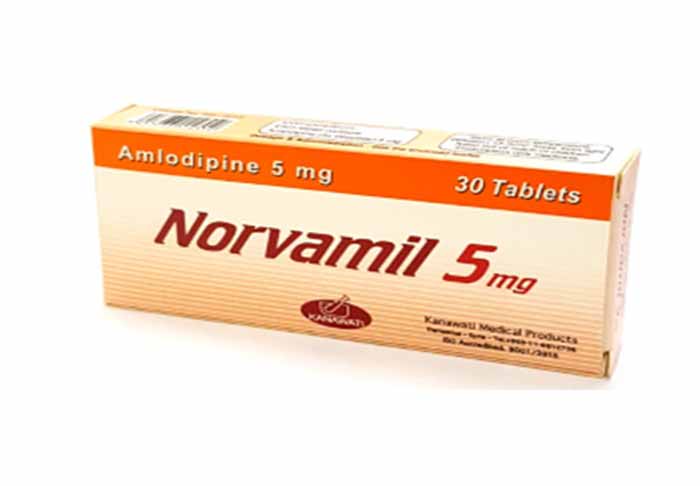
the name
norvamil 5 mg
Lotion symbol
T3
Pharmaceutical form
Tablets
License number and date
465/2012
2/12/2012
Indication
Coronary ischemic medications
Ischemic Coronary drugs
Shelf life
3 years
Quantity
20 Compressed
Installation
Amlodipine ( Besilate ) 5 mg.
Excipients
A- Dipine, microcrystalline cellulose, dibasic calcium phosphate, sodium starch glycolate, magnesium stearate, yellow iron oxide for 10 mg..
Pharmacological properties and mechanism of action:
Amlodipine is a calcium analogue )Calcium ionomer or slow channel blocker( Selectively inhibits the flow of calcium ions across cellular membranes with an effect on vascular muscle cells
Smooth cells have a greater effect on cardiac muscle cells. Amlodipine does not affect serum calcium concentration.
Amlodipine is a peripheral arterial vasodilator that directly affects vascular smooth muscle, leading to a decrease in peripheral vascular resistance and thus lowering blood pressure..
Amlodipine reduces total peripheral resistance )Afterload( It reduces the resulting pressure rate and thus the heart's oxygen requirements at any stage of effort.
Amlodipine inhibits constriction and restores blood flow in the coronary arteries and arterioles in response to calcium, epinephrine potassium, serotonin, and thromboxane A2.
Pharmacokinetics:
Absorption: Amlodipine reaches maximum plasma concentration after ) ٦ – 12 hour( When taken alone, its absolute bioavailability is estimated at between ) ٦٤ % and 90 %(. The bioavailability of amlodipine does not change
In the presence of food.
Distribution: Related about ) 93 %( Amlodipine is found in circulation with plasma proteins in patients with high blood pressure.
Metabolism: Amlodipine is significantly transformed )about 90 %( To inactive metabolites via hepatic metabolism, and excreted ) ١٠ %( Of medicine and) ٦٠ %( Of metabolites in urine.
Subtraction: Amlodipine is eliminated in two phases, with a terminal elimination half-life of approx ) ٣٠ – 50 hours(. Plasma levels of amlodipine reach steady state after ) ٧ – 8 days( Whoever eats
Consecutive daily doses.
Indications:
Amlodipine is used to treat the following conditions, alone or in combination with other medications:
-1 High blood pressure.
-2 Coronary artery disease:
– Chronic stable angina.
– Vasospasm angina )Prinzmetal or variable angina(.
– Angiographically proven coronary artery disease.
Contraindications:
Amlodipine is contraindicated in patients who are hypersensitive to amlodipine.
Pregnancy and breastfeeding:
Gestational classification ) :)C
There are no adequate and well-controlled studies in pregnant women. Amlodipine should be used only if the potential therapeutic benefit outweighs the potential risk to the fetus.
Breastfeeding mothers:
It is not known whether amlodipine is excreted in human milk, and in the absence of this information, breastfeeding mothers are advised to discontinue breastfeeding when taking amlodipine.
Driving and using machines:
Warnings and precautions:
Low pressure: Occasional hypotension may occur, especially in patients with severe aortic stenosis. Severe hypotension is unlikely because the effect begins gradually.
Risk of myocardial infarction or increased angina: Acute myocardial infarction may develop and angina may worsen after starting treatment or increasing the dose of amlodipine, especially in patients with severe obstructive coronary artery disease..
Withdrawal of beta blockers: Amlodipine is not a beta-blocker, so it does not provide protection against the risk of sudden beta-blocker withdrawal. The withdrawal process must be by gradually reducing the beta-blocker dose..
Patients with liver failure: Since amlodipine is extensively metabolized in the liver, the plasma elimination half-life is limited ) 56 hours( In patients with liver failure, the dose should be adjusted slowly when administering amlodipine
For patients with acute liver failure.
Drug interactions:
Laboratory studies indicate that amlodipine has no effect on the binding of digoxin, phenytoin, warfarin, or indomethacin to plasma proteins..
Simvastatin: The concentration of simvastatin increases when combined with amlodipine. The dose for simvastatin should be maximum ) 20 mg( Daily in patients taking amlodipine.
Inhibitors ) CYP3A4 (: The combination of amlodipine with inhibitors increases ) CYP3A4 ( )Moderate and severe( From amlodipine concentration, monitor for symptoms of hypotension and edema when coadministered
To determine the need for dose adjustment.
Catalysts ) CYP3A4 (: There is no information about the quantitative effects of stimulants ) CYP3A4 ( On amlodipine. Blood pressure should be monitored when amlodipine is coadministered with stimulants ) .)CYP3A4
Cyclosporine: The study on kidney transplant patients showed an average increase of 40% % In the level of cyclosporine when treated simultaneously with amlodipine.
Side effects
The most common side effects are headache and nasal congestion. The frequency is more than 1.0 % Headache, fatigue, nausea, abdominal pain, drowsiness.
The following effects occurred at a rate ranging between: ) ١‚ ٠- ١%( In patients during controlled clinical studies:
Cardiovascular system: Arrhythmia, bradycardia, chest pain, hypotension, peripheral ischemia, syncope, tachycardia, dizziness and vasculitis..
Central and peripheral nervous system: Hypoesthesia, peripheral neuropathy, numbness, tremor and dizziness.
Gastrointestinal system: Anorexia, constipation, indigestion, diarrhea, flatulence, pancreatitis, vomiting, and gingival hyperplasia..
general: Allergic reactions, back pain, weakness, facial flushing, malaise, pain, coldness and stiffness, weight gain and weight loss..
Skeletal muscle: Joint pain, arthrosis, muscle spasms, and myalgia.
Psychologically: Sexual dysfunction in males and females, insomnia, nervousness, depression, abnormal dreams, anxiety, and depersonalization.
Respiratory system: Shortness of breath, nosebleeds.
Leather and its accessories: Angioedema, erythema multiforme, pruritus, rash, erythematous rash, and maculopapular rash..
Senses: Blurred vision, conjunctivitis, double vision, eye pain, and tinnitus.
Urinary system:Frequent urination, urination disorders, and nocturia.
Autonomic nervous system: Dry mouth and increased sweating.
Metabolism and nutrition: High blood sugar, thirst.
Blood components: Leukopenia, purpura, and thrombocytopenia.
Dosage and method of use:
Adults: The initial dose of amlodipine as an antihypertensive agent ) 5 mg( Once daily and the maximum dose ) 10 mg( Once daily.
You can start with a dose ) 5.2 mg( Once daily for frail or elderly patients or patients with hepatic impairment. This dose may also be used when adding amlodipine to other antihypertensive medications..
The dose is adjusted according to the patient's need. Usually the dose should be increased every time ) 7 to 14 days( This allows the physician to evaluate the patient's response to each dose level. The dose can be increased more quickly
When the clinical condition of the patient is ensured, and provided that the patient's response is repeatedly evaluated.
Angina: The recommended dose of amlodipine for chronic stable angina or spastic angina is: ) 5 to 10 mg(It is suggested that the dose be lower for elderly patients and patients with deficiency
Hepatic. Most patients need ) 10 mg( To obtain a favorable effect.
Coronary artery disease: The recommended dose of amlodipine for patients with coronary artery disease ranges from ) 5 to 10 mg(Most patients in clinical studies required... ) 10 mg(.
children: The effective daily dose for children is: ) ٦ – 17 years old(, from ) 5.2 mg to 5 mg(No study has been conducted on a daily dose greater than ) 5 mg( In sick children. The effect of amlodipine on...
Blood pressure in pediatric patients under six years of age is unknown.
the elderly: In general, dose selection for the elderly should be done with caution, usually starting with the lowest dose in the dosing range, as this reflects the high frequency of decreased hepatic, renal, or cardiac function.
Associated diseases or other treatments. Elderly patients have a decreased clearance of amlodipine, increasing the AUC to approximately 40 – ٦٠ % This may require a lower initial dose.
Overdose:
Overdose:
Overdosage would be expected to cause increased peripheral vasodilation with marked hypotension and possible tachycardia reaction. If an overdose of amlodipine occurs, it should be initiated
With effective cardiac and respiratory monitoring, frequent blood pressure measurement is essential. Cardiac support should be provided when hypotension occurs which includes elevation of the lower extremities and judicious administration
For liquids. If hypotension persists and does not respond to these measures, then vasoconstrictors such as phenylephrine should be given and circulating volume and urine excreted monitored.. As amlodipine
It is highly bound to blood proteins so it is useless to perform hemodialysis.
Packing:
Blister strips, each strip contains 10 tablets each of Norfamil 5 mg and Norfamil 10 mg.
Preservation and storage conditions:
Store at room temperature, between 15 – 30°C.
Away from light
Keep out of reach of children.
It is only dispensed with a medical prescription
WhatsApp us