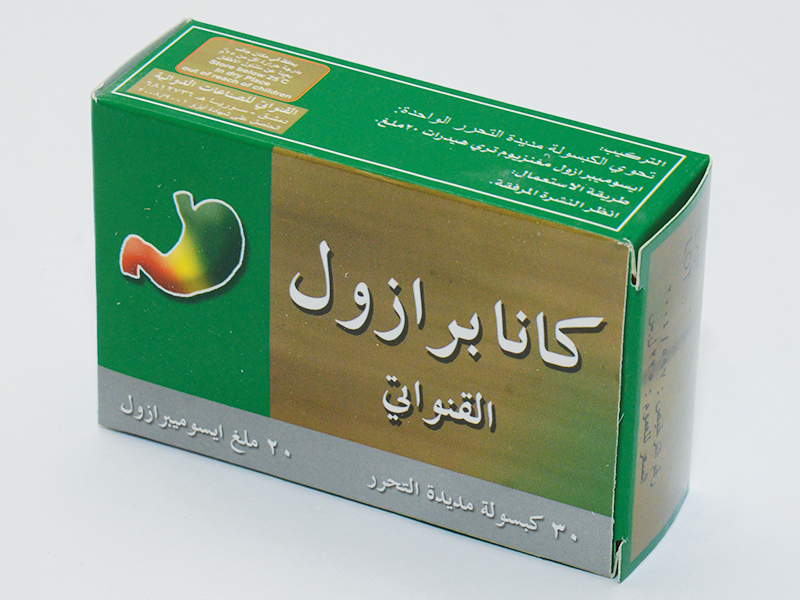
the name
cannaprazole 20 mg
Lotion symbol
CA-04
Pharmaceutical form
Capsule
License number and date
597/2004
03/11/2004
Therapeutic group
Medicines to treat ulcers
Shelf life
4 year
Installation
Esomeprazole 20 mg
Excipients
Sugar granules complementary to the capsule.
Pharmacological properties and mechanism of action:
Impact mechanism :
Esomeprazole is a proton pump inhibitor that suppresses gastric acid secretion by specifically inhibiting the H/K+ ATPase pump in the gastric parietal cell.. The S and R isomers of esomeprazole are added to a proton and are transformed in the acidic environment of the parietal cell, forming the effective inhibitory form of acrylic sulfenamide, which acts specifically on the proton pump. Esomeprazole inhibits the final step in acid production, thus reducing stomach acidity
Pharmacokinetics:
Absorption:
After oral administration, peak plasma levels are reached (Cmax) It occurs at approx 1.5 hour (Tmax)Cmax increases proportionally when the dose is increased. When repeating doses once daily with 40 mg, systemic bioavailability is approx 90% compared to 64% After one dose of 40 mg.
Distribution :
Esomeprazole is associated with... 97% With plasma proteins.
Metabolism:
Esomeprazole is extensively metabolized in the liver via the cytochrome P450 enzyme system (CYP).
Elimination:
The elimination half-life of esomeprazole is approx 1 to 1.5 hour. subtracts less than 1% of the original drug in the urine.
– While approx 80% of the oral dose in the form of inactive metabolites in the urine, and the remaining inactive metabolites are found in the feces.
Indications:
Treatment of gastroesophageal reflux disease (GERD):
1- Treatment of erosive esophagitis:
For short-term treatment (4-8 Weeks) In recovery and resolution of symptoms of erosive esophagitis confirmed by the diagnosis. For patients who have not yet recovered 8 weeks of treatment, an additional course may be considered 4-8 Weeks. In infants 1 month to less than 1 year, enteric-coated, delayed-release esomeprazole capsules are indicated for short-term treatment. (until 6 Weeks) From erosive esophagitis due to acid resulting from gastroesophageal reflux.
2- Maintaining recovery from erosive esophagitis:
To maintain healing of erosive esophagitis and keep symptoms of erosive esophagitis at bay. The controlled studies were not extended for longer than 10 minutes 6 months.
3- Symptomatic gastroesophageal reflux disease:
For short-term treatment (4-8 Weeks) Heartburn and other symptoms associated with gastroesophageal reflux in adults and children one year or older.
Contraindications:
It is contraindicated in patients with hypersensitivity to benzimidazole derivatives or any of the components of the preparation
Pregnancy and breastfeeding:
Pregnancy:
Teratogenic effects : Pregnancy category C
There are no adequate, well-controlled studies with esomeprazole magnesium in pregnant women, and it should not be used during pregnancy unless the potential benefit outweighs the potential risk to the fetus..
Breastfeeding:
Esomeprazole is likely to be present in human milk. Caution should be exercised when esomeprazole magnesium is administered to a nursing woman.
Driving and using machines:
Warnings and precautions:
– The symptomatic response to treatment with esomeprazole magnesium does not prevent gastric metastasis.
– Gastritis atrophy is sometimes observed in gastric biopsies in patients treated for a long period with omeprazole, whereas esomeprazole is its enantiomer.
– Acute interstitial nephritis has been observed in patients taking proton pump inhibitors including esomeprazole magnesium. It may occur at any point during treatment and is generally due to an idiopathic hypersensitivity reaction. The drug should be discontinued if acute interstitial nephritis develops..
– Daily treatment with any acid secretion inhibitor medication over a long period of time (For example more than 3 years) It may lead to malabsorption of vitamin B12 resulting from deficiency or absence of hydrochloric acidity. This diagnosis should be considered if clinical symptoms of vitamin B12 deficiency are observed.
– Studies have published that treatment with proton pump inhibitors such as esomeprazole magnesium may be associated with an increased risk of Clostridium difficile-associated diarrhea, especially in hospitalized patients.. This diagnosis should be considered for diarrhea that does not improve and patients should use the lowest dose for the shortest duration appropriate for the condition being treated .
– Observational studies suggest that treatment with proton pump inhibitors (PPI) It may be associated with an increased risk of osteoporosis-related fractures of the hip, wrist, and spine. The risk of fracture is increased in patients receiving a high dose, defined as multiple doses daily.
– Long-term treatment with proton pump inhibitors. Patients should use the lowest dose and for the shortest possible duration for the condition being treated. Patients at risk of osteoporosis-related fractures should be directed according to established treatment guidelines. .
– Cases of hypomagnesemia, with or without symptoms, have been reported rarely in patients treated with proton pump inhibitors for at least three months. .
– In most cases, after a year of treatment, most patients experience hypomagnesemia, requiring magnesium supplements and discontinuation of proton pump inhibitors..
– Patients who are expected to be on treatment for long periods or who are taking proton pump inhibitors with drugs such as digoxin or drugs that may cause hypomagnesemia. ( For example : Diuretics ) Health care professionals may consider magnesium levels before starting treatment and periodically .
– Drug-induced hypogastric acidity results from hyperplasia of chromogenic intestinal cells and increased serum levels of chromogranin A, which may interfere with screening tests for neuroendocrine tumors.
Drug interactions:
– Interference with antiviral therapy:
The concomitant use of atazanavir and nelfinavir with proton pump inhibitors is not recommended. It is expected that the combination of atazanavir with proton pump inhibitors will lead to a significant decrease in plasma concentrations of atazanavir and may lead to loss of therapeutic effect and the development of drug resistance. It is expected that the combination of saquinavir with proton pump inhibitors may increase the concentration of saquinavir, which will increase toxicity and require a dose reduction..
Tacrolimus:
Coadministration of tacrolimus with esomeprazole may increase serum levels of tacrolimus.
Medications whose absorption can affect PH Stomach:
Due to its effects on gastric acid secretion, esomeprazole reduces the absorption of drugs such as ketoconazole, atanvir, and iron salts, as gastric pH is an important factor in their bioavailability.. For example, the absorption of some drugs such as ketoconazole, iron salts, erlotinib and mycophenolate mofetil can be reduced. (MMF ) While the absorption of drugs such as digoxin may increase the impairment of treatment with esomeprazole, patients may therefore need to monitor digoxin levels when taken concomitantly with esomeprazole.
Mycophenolate mofetil (MMF):
The absorption of drugs such as mycophenolate mofetil can be decreased when combined with lansoprazole. Patients may need to monitor mycophenolate levels when administered concurrently with lansoprazole.
Coadministration of lansoprazole in healthy subjects and transplant patients receiving MMF has been reported to reduce exposure to active metabolites.. Lansoprazole should be used with caution in transplant patients receiving MMF.
Effect on hepatic metabolism / Cytochrome P-450 pathways:
Lansoprazole has a broad effect on both CYP2C19 and CYP3A4.
Patients treated concomitantly with proton pump inhibitors and warfarin may need to be monitored for increases in INR and prothrombin time..
Concomitant use of fluvoxamine (CYP2C19 inhibitor) With lansoprazole, exposure to lansoprazole increased by 4 fold, so a dose reduction may be needed.
Lansoprazole is not expected to interact clinically with theophylline or piroxicam, but concurrent use with lansoprazole may require dose adjustment..
Poor metabolism via CYP2C19 such as fluvoxamine may more than double lansoprazole exposure, and may require dose adjustment in patients with Zollinger-Ellison syndrome who require higher than usual doses..
Concomitant use of lansoprazole with clarithromycin and amoxicillin may result in increased plasma levels of lansoprazole and clarithromycin..
Caution should be exercised as drugs that induce CYP2C19 or CYP3A4 (Such as St. John's wort or rifampin) It can significantly reduce lansoprazole concentrations. Concomitant use of lansoprazole with St. John's wort or rifampin should be avoided.
Nitrobiotics: Studies suggest that concomitant use of proton pump inhibitors may result in elevated levels of methotrexate and/or its metabolite, potentially leading to methotrexate toxicity.. In high dose methotrexate temporary withdrawal of the proton pump may be considered in some patients.
Clopidogrel:
The simultaneous use of esomeprazole magnesium with clopidogrel should be avoided and alternative antiplatelet therapy should be adopted as an alternative, as esomeprazole may inhibit the metabolism of clopidogrel to its active metabolite by using cytochrome c with other drugs such as esomeprazole that inhibit the activity of the enzyme.
Side effects
Dosage and method of use:
Overdose:
Packing:
Preservation and storage conditions:
– Store at a temperature below 30°C in a dry place
– Keep out of reach of children
WhatsApp us