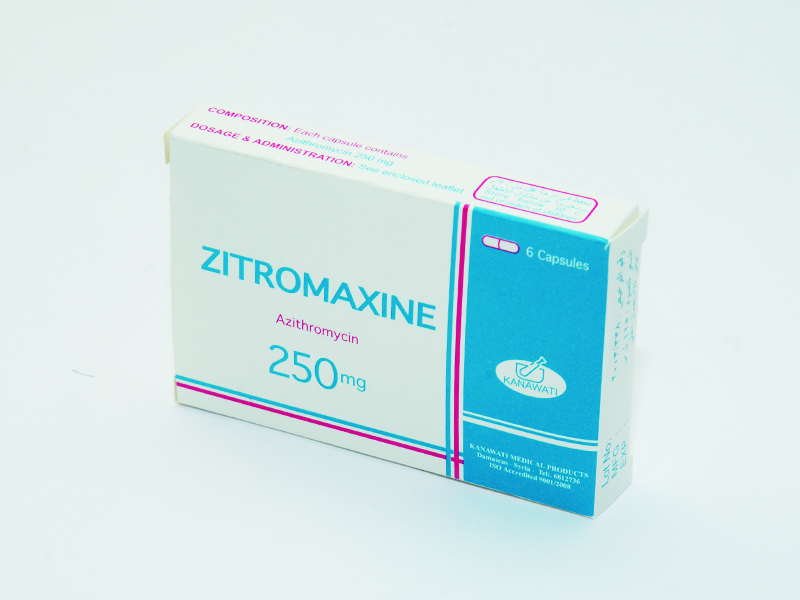
the name
Zitromaxine 250 mg
Lotion symbol
CA-02
Pharmaceutical form
Capsule
License number and date
338/2003
29/12/2003
Therapeutic group
Antibacterial drugs
Shelf life
4 year
Installation
Azithromycin 250 mg
Excipients
Lactose, corn starch, magnesium stearate, sodium lauryl phosphate, talc .
Pharmacological properties and mechanism of action:
It contains the active ingredient azithromycin, which is azalide, a class of antibiotics from the macrolide group..
Impact mechanism :Azithromycin works by binding to the ribosome subunit 50 S in germs that are sensitive to it, thus interfering with bacterial protein synthesis without affecting DNA synthesis.
In vitro and clinical studies indicate that azithromycin has activity against most of the following bacterial strains: :
1 – 1 – Gram-positive aerobic bacteria : Golden nodules, adenoid nodules, pulmonary nodules, and pyogenic nodules
note : Azithromycin shows cross-resistance with gram-positive strains resistant to aromycin, as most strains of Enterococcus faecalis and methicillin-resistant Staphylococcus aureus and Staphylococcus strains do not respond to azithromycin. .
2 – Aerobic bacteria : Gram negativity : Haemophilus ducreyi, Haemophilus parainfluenzae, Moraxella influenzae, and Neisseria gonorrhoeae .
– Other germs : Chlamydia pneumoniae, Chlamydia trachomatis, and M. pneumoniae
* note : Beta-lactamase production has no effect on the effectiveness of azithromycin
Pharmacokinetics:
Azithromycin is well absorbed from the digestive system after oral administration and is widely distributed throughout the body. The speed of distribution through tissues and the increase in the concentration of azithromycin within cells makes its concentration in tissues greater than its concentration in serum or plasma. ( 50 times greater than its concentrations in plasma)
The bioavailability is about 37%, and the time required to reach maximum levels in plasma ranges from 2 – 3 hours.
Extended terminal excretion half-life of the compound ( ٢ – 3 days).
Biliary excretion of azithromycin in its unchanged form is the major predominant route of excretion of the drug.
When taking the capsule with food, absorption speed increases( Cmax) For azithromycin, it decreases by 52%, and the extent of absorption decreases( AUC) by 43%
Indications:
Zitromaxine is used ( Azithromycin ) In the treatment of patients with mild or moderate infections caused by susceptible strains of the above-mentioned bacteria in the following cases :
Adults :
– Acute bacterial exacerbations of chronic obstructive pulmonary disease caused by Haemophilus influenzae, Moraxella influenzae, or Streptococcus pneumoniae .
– Acquired pneumonia caused by Chlamydia pneumoniae, Haemophilus influenzae, or M. pneumoniae in patients responding to oral therapy .
– Uncomplicated skin and skin structure infections caused by Staphylococcus aureus, pyogenic nodules, or incisive nodules. Abscesses usually require surgery. .
– Urethritis or inflammation of the uterus caused by Chlamydia trachomatis and Neisseria gonorrhoeae .
– Genital ulcer disease : Which occurs in men due to infection with Haemophilus ducreyi ( Eating ulcer ) .
children :
– Acute otitis media : Caused by Haemophilus influenzae, Moraxella influenzae, or Streptococcus pneumoniae .
– Acquired pneumonia : Caused by Chlamydia pneumoniae, Haemophilus influenzae, M. pneumoniae, or Streptococcus pneumoniae in patients responding to oral therapy.
– Pharyngitis and tonsillitis : Caused by Streptococcus pyogenes as an alternative to first-line treatment in patients who cannot use first-line treatment
–
Contraindications:
Zitromaxine should not be used ( Azithromycin ) In patients with hypersensitivity to azithromycin, erythromycin, or other macrolide antibiotics. .
Pregnancy and breastfeeding:
Pregnancy :
There is not sufficient data for the use of azithromycin in pregnant women, as the safety of azithromycin during pregnancy has not been confirmed. Therefore, azithromycin should be used during pregnancy if its benefits outweigh its harms. .
Breastfeeding :
It is not known whether azithromycin is excreted in breast milk, as there are no adequate, controlled clinical studies in breastfeeding women in whom it has been proven that azithromycin is excreted in breast milk. Therefore, azithromycin should be used with caution in breastfeeding women only when there are no sufficient alternatives. .
Driving and using machines:
Warnings and precautions:
Drug and food interactions :
The aluminum and magnesium in antacids reduce maximum levels in the blood ( Absorption speed ) But it does not affect the area under the curve ( extent of absorption ) , but it does not affect the area under the curve ( extent of absorption ) The combination of macrolides with theophylline may be associated with an increase in theophylline concentrations in the blood, and the combination of macrolides with warfarin may be associated with an increase.
Side effects
Dosage and method of use:
Overdose:
Packing:
Preservation and storage conditions:
– Store at a temperature below 30°C in a dry place
– Keep out of reach of children
WhatsApp us