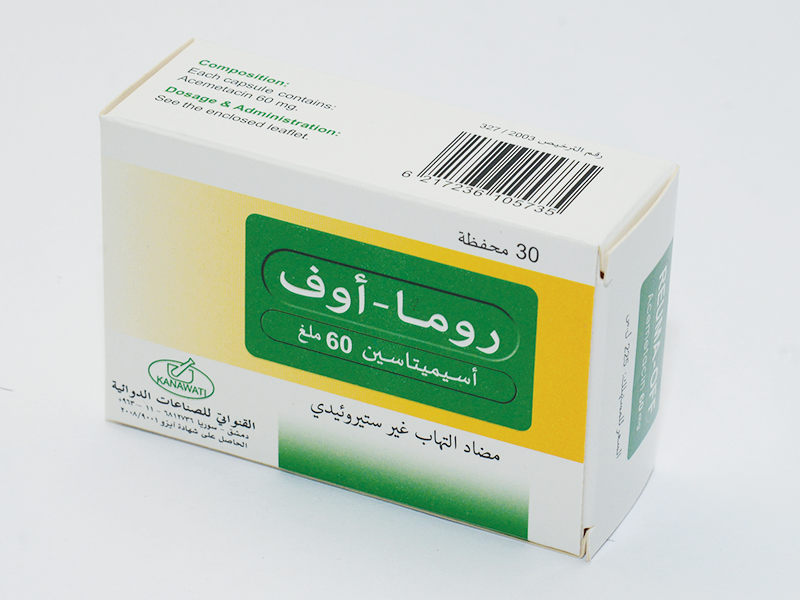
the name
Rome – Oof
Lotion symbol
CA-01
Pharmaceutical form
Capsule
License number and date
327/2003
09/11/2003
Therapeutic group
Non-steroidal anti-inflammatory drugs
Shelf life
4 year
Installation
Acemetacin 60 mg
Excipients
Lactose, magnesium suppositories
Pharmacological properties and mechanism of action:
Rome – Oof ( Acemetacin ) It is a non-steroidal anti-inflammatory drug, as it is used to relieve pain and inflammation and reduce fever, in addition to its use in musculoskeletal diseases and arthritis. .
Pharmacokinetics:
It sucks ( Acemetacin ) From the digestive system and metabolized to its primary receptor, indomethacin. Its peak concentrations in plasma reach two hours after ingestion. .
Both acemetacin and indomethacin are highly bound to plasma proteins. Acemetacin is eliminated by the renal and hepatic routes, but its pharmacokinetics are not affected by mild to moderate renal or hepatic impairment. .
Indications:
Rome is used – Oof ( Acemetacin ) In the treatment of musculoskeletal diseases and joint diseases such as spondyloarthritis, osteoarthritis, and articular rheumatism, it is also given as a short-term treatment for some conditions such as bursitis, tendonitis, and acute gouty arthritis. It can also be used as rheumatoid arthritis. – Oof ( Acemitacin is used to relieve pain, edema, and inflammation resulting from surgical and orthopedic orthopedic procedures, in addition to relieving mild to moderate pain in some cases such as dysmenorrhea. Acemitacin has been used as a nutritional supplement in treatment with morphine in cases of pain following surgical operations. .
Contraindications:
Hypersensitivity to the components, and should not be given ( Acemetacin for patients who have asthma attacks or allergies as a result of taking aspirin and other non-steroidal anti-inflammatory drugs that cause gastrointestinal bleeding.
Pregnancy and breastfeeding:
It should not be given to pregnant or breastfeeding women .
It is also not recommended to give it to children and the elderly .
Driving and using machines:
The ability to drive or operate heavy machinery may be affected during treatment with acemetacin
Warnings and precautions:
Like other non-steroidal anti-inflammatory drugs, acemetacin should not be given to patients with peptic ulcers or patients with a history of gastrointestinal bleeding. Acemetacin can mask the symptoms of infection, so it should be used with caution in the presence of infectious cases..
Caution should be exercised when administering acemetacin to patients with epilepsy, Parkinson's disease, and other psychiatric disorders .
In case of long-term use, it is recommended to conduct periodic tests for renal and liver function and regular blood counts .
Eye changes may occur if used to treat chronic joint diseases, so these patients must undergo periodic eye examinations. .
Treatment must also be stopped if these changes occur .
Drug interactions:
Using aspirin with acemetacin reduces the concentrations of the latter in the blood by a percentage 20 % .
The use of diflunisal with acemetacin reduces renal excretion and increases acemetacin concentrations in plasma. .
It can also lead to gastrointestinal bleeding, which can be fatal .
It is also not given with anticoagulants and other non-steroidal anti-inflammatory drugs
Side effects
Common side effects include abdominal pain, indigestion pain, nausea, diarrhea, constipation, bloating, lack of appetite, rash, itching, dizziness, headache, and nervousness. .
Dosage and method of use:
One wallet 2 – 3 Times daily with fluids after food .
– Or according to the doctor's instructions
Overdose:
Packing:
Blister number 3 Contains one blister 10 Gelatin wallets .
Preservation and storage conditions:
– Store at between temperatures 15 – 30°M .
– Store away from light and moisture .
– Keep out of reach of children .
WhatsApp us